Corin
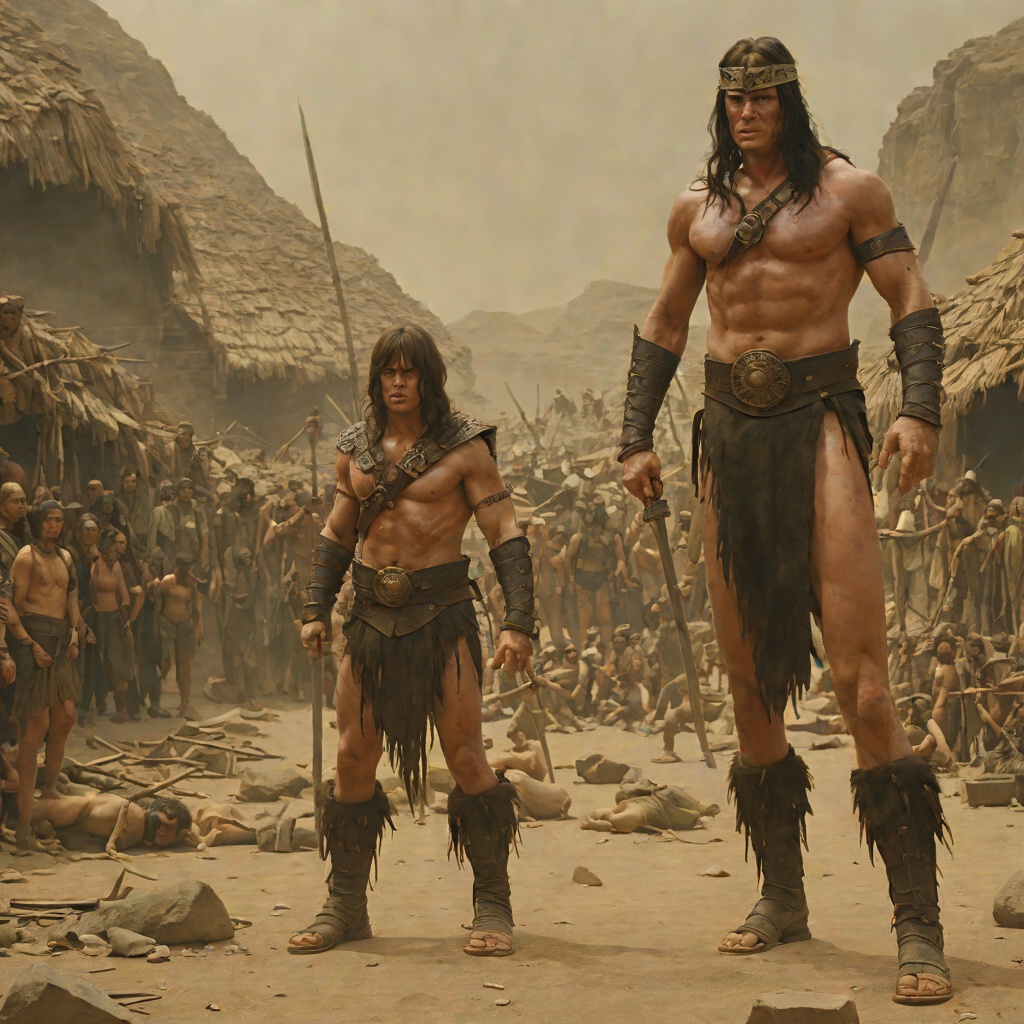
Conan the BarbarianCorin the smith, father of Conan, is a figure of profound influence whose life and death define the course of his son's destiny. A burly, bearded man of gigantic stature, he appears on a rocky ridge swept clear of snow, braced against a furious storm, with his nine-year-old son beside him. In this elemental setting, Corin performs an ancient rite, drawing an enormous two-handed sword and chanting a rune spell as lightning rends the sky. He imparts to Conan the central creed of his life: that the mightiest of gods is Father Crom, who rules earth and heaven and the sea, and that the greatest secret Crom guards is the secret of steel, a knowledge the gods did not teach to men but kept jealously in their hearts. He tells of giants who once dwelt within the earth, crafty and wise, who stole from Crom the secret of the silvery metal that, when bent, springs into shape again. Corin's words on that night become the philosophical bedrock of Conan's existence, remembered all his life and ultimately echoed in his final victory over Thulsa Doom.
Identity and Background
Corin is not merely a blacksmith but a keeper of an arcane art. He came out of the south lands, bearing within him the secret of steel, a precious inheritance from the ancient Atlanteans, believed lost and forgotten by all who lived in this darkling age. His neighbours regard him as something of a warlock for his ability to turn iron into steel, a reputation he acknowledges with a wry humor, saying he would not disappoint them. In the forge, he is a master of his craft, driving the bellows tirelessly, drawing white-hot iron from the furnace, and hammering it into shape on the anvil, each blow spraying sparks into the ruddy gloom. He is a godling to his neighbours, a figure of awe and mystery, yet his stern gaze gentles when he sees his son watching from the doorway, and he allows the boy to observe the forging, a lesson in the transformation of iron into steel that mirrors the forging of a man's heart.
The Riddle of Steel and the Father's Teaching
Corin's philosophy, delivered in the storm and at the forge, is the moral and spiritual core of the narrative. He teaches Conan that before a man is worthy to bear a sword of steel in battle, he must learn its riddle, must understand the ways of steel. He declares that in all the world one can trust no one, neither man nor woman nor beast, neither spirit nor demon nor god, but one can trust a blade of well-forged steel. He cups his son's small hands within his own and curls the boy's fingers about the hilt of the great sword, saying that the heart of a man is like a piece of unworked iron, which must be hammered by adversity and forged by suffering, purged and hardened in the fires of conflict, purified and shaped on the anvil of despair and loss. Only when the heart has become as steel, he says, will one be worthy to wield a keen-edged sword and win against enemies, as the gods did when they conquered the dark giants. When one has mastered the mysteries of steel, his sword will be his very soul. These words, spoken on that lightning-riddled night, are remembered by Conan all his life, and he comes to comprehend their meaning: out of suffering is born strength; only through pain and deprivation does a human heart become as strong as steel.
The Raid and Corin's Death
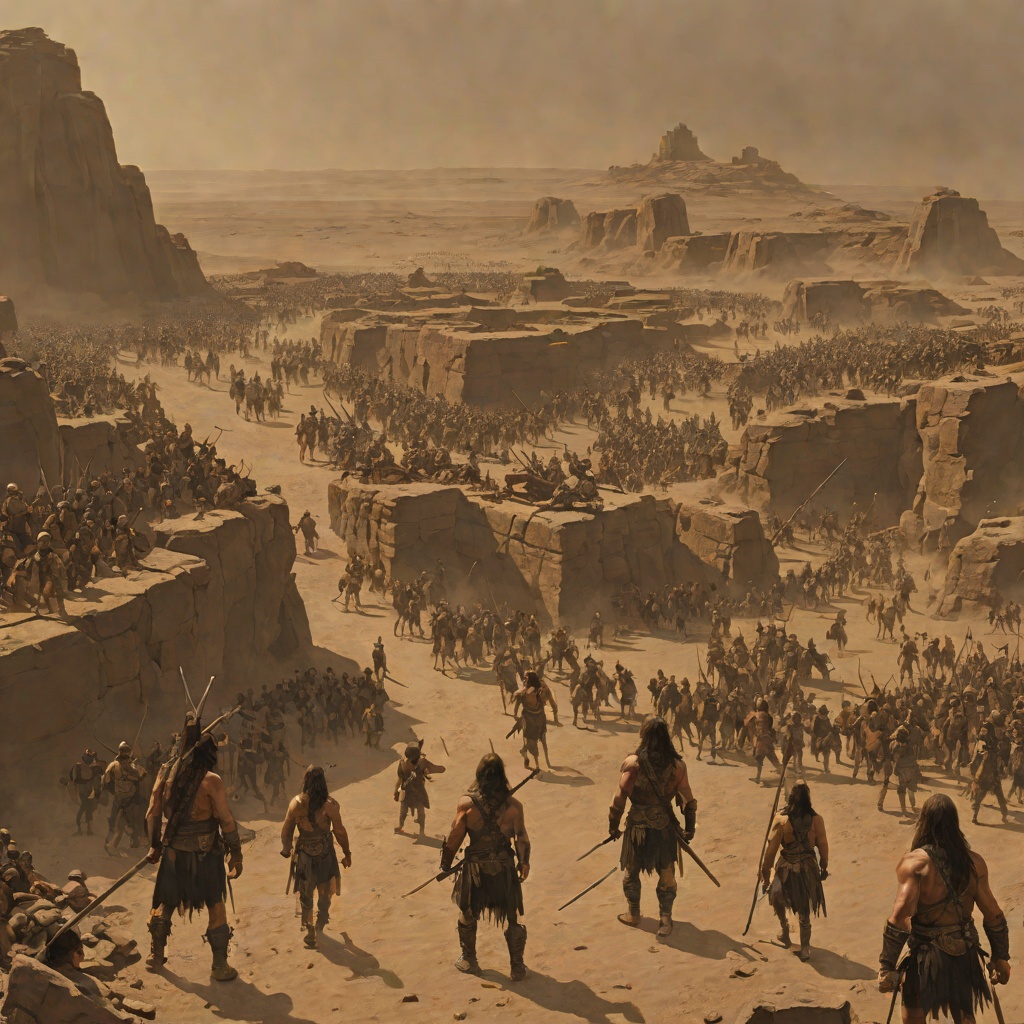
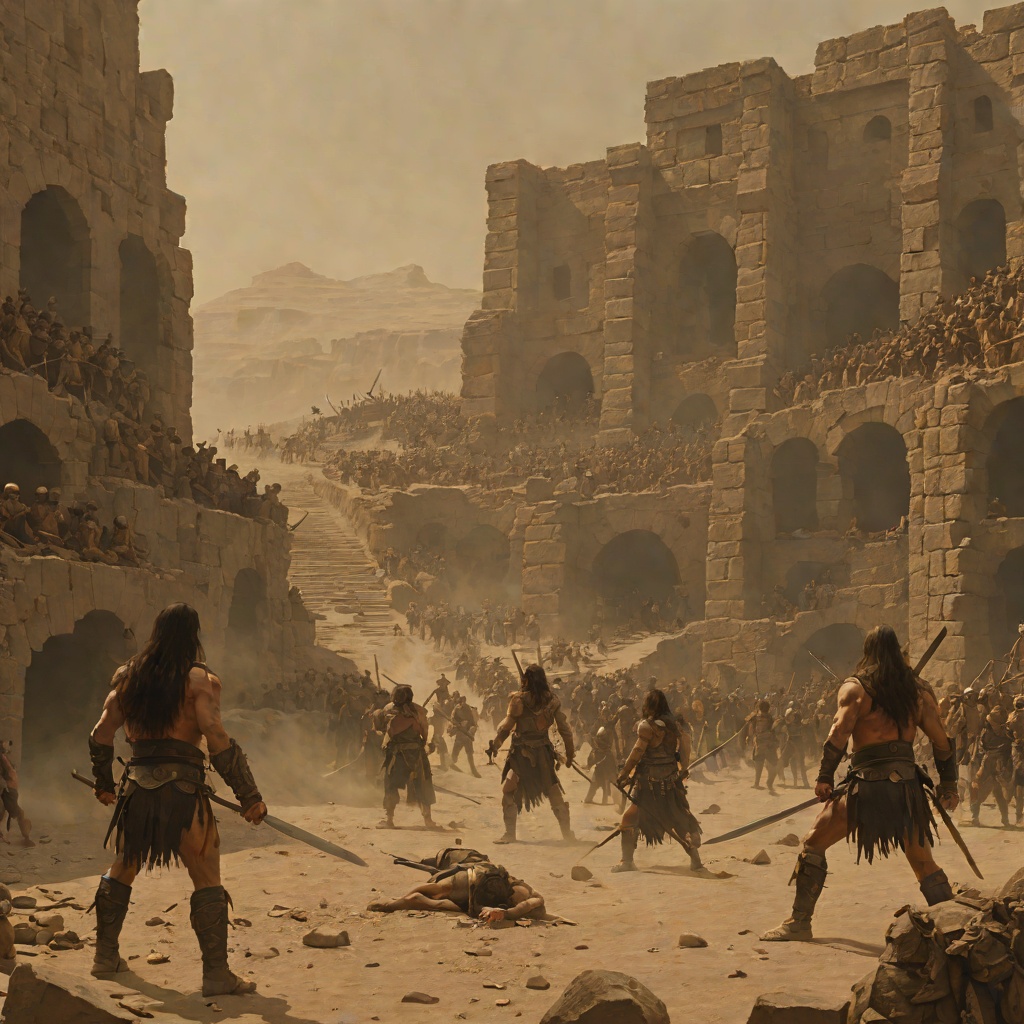
Corin's life ends in the brutal raid on the Cimmerian village, an event that shatters Conan's childhood and sets him on his path of vengeance. The raiders, Vanir horsemen shod in iron, crash through the bushes and sweep down upon the hamlet, their axes, spears, and swords glinting in the frozen dawn. Corin, roaring "The Vanir!" as he swings his blacksmith's hammer, plunges from the mouth of his hut to meet the invaders. The boy Conan stands on the doorstep, staring in bewilderment at the chaos, but there is no order. The village is overwhelmed; women are shrieking, children are pulled down by hounds, and a naked Cimmerian hunter hews a raider's leg away with a huge axe. In the aftermath, Corin lies on the rutted roadway, his inert hand a finger's length away from the weapon that was his final masterpiece. The commander, Rexor, points to the fallen smith, and a foot soldier lifts the blade that no man could have wrested from Corin's living grasp. Conan, watching in fearful fascination, is borne in upon with hideous certainty that his father lives no more. His mother, Maeve, touches his shoulder as he fights back sobs, and a soldier laughs. The raiders take the sword, and Conan sees the standard of Thulsa Doom, embroidered with writhing serpents upholding the orb of a sable sun, a symbol that will haunt his dreams.
Legacy and Influence
Corin's death is not an end but a beginning. The sword he forged, the Atlantean blade, becomes the object of Conan's quest, and the philosophy he imparted becomes the lens through which Conan interprets his world. In the depths of his enslavement, chained to the Wheel of Pain, Conan remembers his father's words about suffering and strength. When he prays to Crom, he does so with the same gruff indifference his father described, acknowledging Crom as aloof and indifferent to the needs of mortals. Corin's teaching about the riddle of steel is ultimately vindicated in Conan's final confrontation with Thulsa Doom. As Conan beheads the cult leader, he speaks his father's creed: "My father was the light of day; Thulsa Doom, my night. Yet in one thing he spoke true. What matters is not the steel within the blade, but the steel within the man." Corin's legacy is thus not merely a weapon or a philosophy, but the very essence of Conan's identity as a Cimmerian, a man-slayer, and a hero. His death is the catalyst for Conan's journey, and his teachings are the compass that guides it, making him a figure of enduring significance in the story.